What Is an AI Employee? A Plain-English Guide for Business Leaders
Chatbot, workflow or agent? A plain-English guide to what an AI employee actually is, what it is made of, and how to tell a real deployment from a demo.
Refer & earn: 30% of a client’s first month, then 10% of every month after that, for up to 24 months per client. See the partner programme →
Chatbot, workflow or agent? A plain-English guide to what an AI employee actually is, what it is made of, and how to tell a real deployment from a demo.
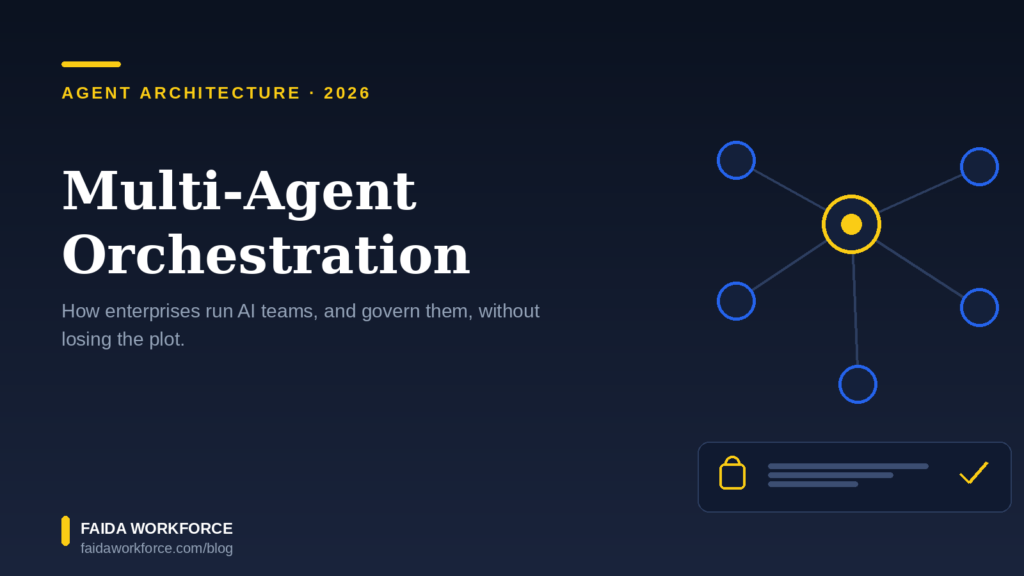
One agent is a tool; several agents working together is an organisation. A practical look at the orchestration patterns that hold up, why multi-agent projects fail, and the security and governance questions regulators now expect you to answer.
Generic chatbots have hit a ceiling. In 2026 the systems doing real work are specialised agents — grounded in your data, given least-privilege access, and measured against real tasks. Here is what changed, and how to pick the right architecture.
Every agent demo works. The question that decides a programme is whether you can prove, with numbers, that it is doing the job — success rate, escalations, cost per resolved task.
Google’s new 12-billion-parameter model runs on 16GB laptops, handles audio and vision without separate encoders, and signals a shift toward local agentic AI. Here’s what business leaders should consider.
Anthropic’s Claude Opus 4.8, released on 28 May 2026, brings measurable gains in honesty, agentic reliability, and cost efficiency. Here’s what business leaders need to know before adjusting their AI workflows.
Meta began cutting roughly 8,000 roles on 20 May 2026 while reassigning 7,000 people to AI teams. For business leaders, the lesson is that AI efficiency is a workforce decision.
Anthropic will give Claude subscribers a separate monthly credit pool for programmatic use starting June 15, according to XDA Developers. The shift ends a subsidy that made agent and API-style work cheaper than it looked — and it changes how businesses should budget for AI agents.
Anthropic introduced a research preview called “dreaming” for its Claude Managed Agents, a process that reviews past sessions to curate long-term memory. Here’s what business leaders need to know about the shift toward self-improving agent systems.
A joint guidance from the US, UK, Australia, Canada and New Zealand tells organisations to fold agentic AI into existing cybersecurity frameworks — and warns that the technology is already running in critical infrastructure with insufficient safeguards.
Google’s Cloud Next 2026 announcements reveal a shift in enterprise AI: the question is no longer whether companies can build an agent, but how they manage thousands of them.
Cloudflare has launched a unified inference layer that lets businesses access over 70 AI models from 12+ providers through a single API. For companies building AI agents, this could simplify model management, cost tracking, and reliability.
A Guardian investigation published 7 April 2026 finds skilled older workers turning to AI data annotation after exhausting other options — a signal for any business deploying AI agents.
Google’s Gemma 4 family brings frontier-level reasoning to hardware you may already own. Here’s what business leaders need to know about the open-model shift.
Refer a business to Faida Workforce and you earn 30% of the client’s first paid month, then 10% of every month for up to 24 months per client — rising to 15% from the accrual after you pass 10 active clients. Paid by PayPal, batched on the 1st.
10 Pro clients = $2,598.70 over 24 months — $3,748.13 at the 15% tier.
Figures are potential earnings worked from the published rates, assuming every referred client pays for the whole cap — not a promise, not an average. The $1 trial is never commissionable.